Abstract
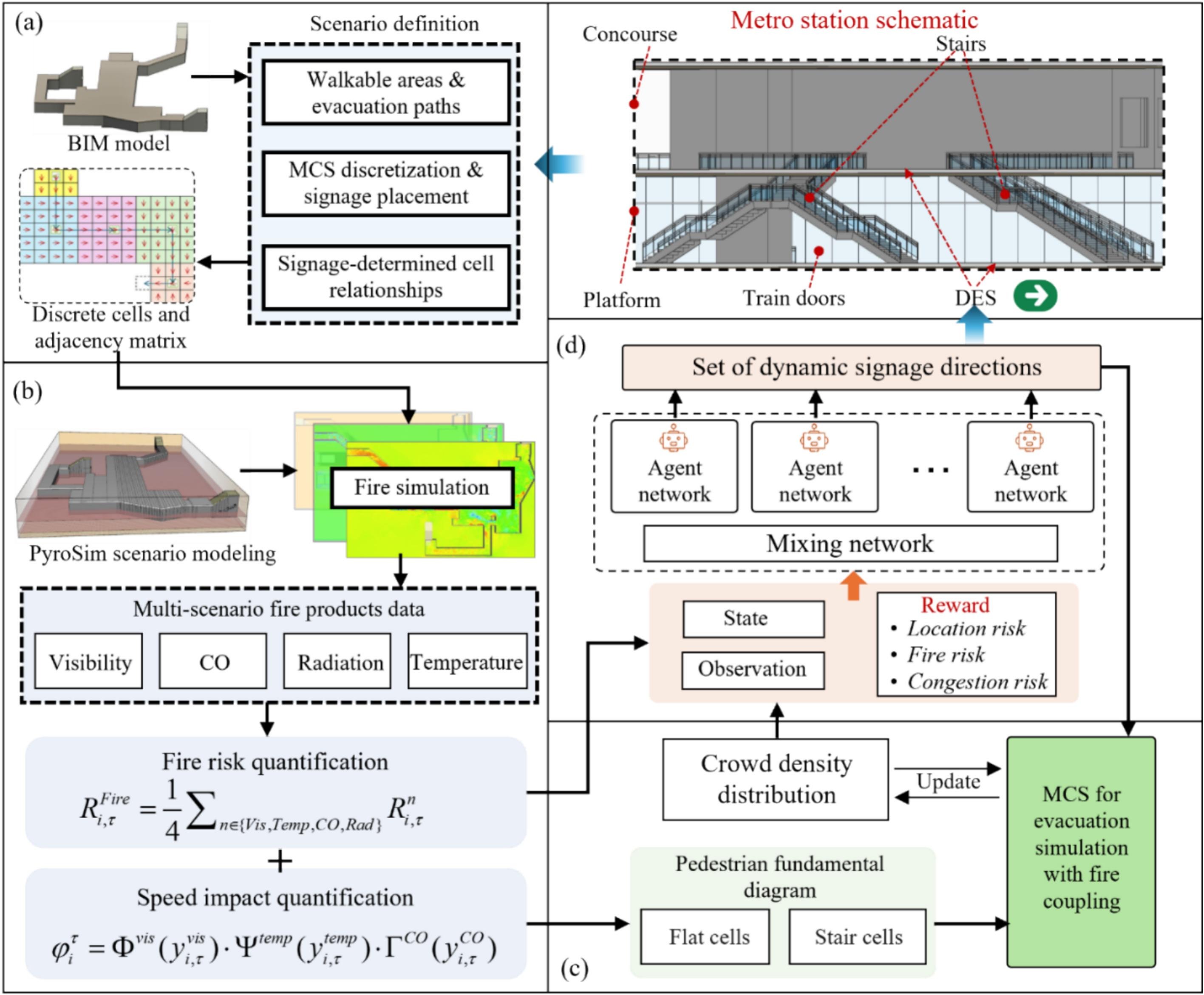
Fire emergencies in multi-level metro stations present complex optimization challenges characterized by high-density passenger flows, vertically coupled spaces, and rapidly evolving hazards. Traditional Static Evacuation Signage (SES) often fails to adapt to the spatiotemporal dynamics of smoke propagation and crowd congestion, leading to inefficient evacuations and increased safety risks. To address these limitations, this study proposes an integrated simulation–optimization framework for intelligent evacuation guidance. The framework establishes a closed-loop coupling among three modules: (1) Physical Fire Modeling using PyroSim to generate high-fidelity hazard fields (e.g., toxic gas, heat) that dynamically degrade evacuee mobility; (2) Mesoscopic Crowd Simulation (MCS) based on an enhanced cell transmission mechanism to capture capacity-constrained flow dynamics in complex underground topologies; and (3) Multi-Agent Reinforcement Learning (MARL) utilizing the QMIX algorithm to coordinate Dynamic Evacuation Signage (DES) agents distributed across multiple floors and functional areas. Numerical experiments conducted across diverse fire scenarios in a real-world metro station demonstrate that the proposed method significantly outperforms the static baseline in enhancing evacuation efficiency and mitigating fire- and crowd-related risks, while exhibiting robust adaptability with the Transfer Learning (TL). Notably, in complex dual-fire scenarios, the approach achieves a reduction in total evacuation time of up to 37.4 %, while simultaneously lowering both cumulative fire risk and crowd safety risks by approximately 68 %. Overall, the proposed coupled simulation–optimization framework demonstrates strong applicability and scalability in resolving multi-objective problems under complex conditions, providing a scientific methodological basis for enhancing the resilience and decision-making accuracy of railway transportation emergency management.